5 Enterprise SEO Tools and What Each One Is Best For
Topic: SEO
Published:
Written by: Bernard Huang
Enterprise organizations have certain bases to cover when shopping for SEO solutions — they need tools that can:
Diagnose website issues that impact performance and provide insights to make improvements.
Show teams how to make the best use of existing site content, and guide strategic content creation.
Effectively report on website content — and what each team, writer, or contractor is doing — to track project outcomes and avoid overlap when planning future content and campaigns.
Support competitor research to learn from other top brands’ SEO strategies and get content in front of the right target audiences.
Integrate with the software in their workflows and streamline current operations.
Unify teams and improve collaboration (even for teams in different locations or enterprise companies that work with freelancers).
Offer flexibility and scalability for evolving business needs, instead of pigeonholing you into preset packages.
Show whether AI answers (from ChatGPT, Gemini, Claude, and Google’s AI Overviews) mention your brand, not just where your pages rank in search results.
So, as you might expect, most enterprise SEO platforms, like seoClarity, Semrush, and Ahrefs, are catered to these needs: they consolidate a lot of features under one roof, have collaborative functionalities, and offer custom packages. (And it makes sense for teams to get started in one of these solutions.)
That said, these large-scale tools are not equally strong in every area — for example, a platform built around technical audits or rank tracking may give you lighter guidance for writing new content and refreshing your existing site content. As a result, many teams end up supplementing these tools with specialized SEO solutions to support more focused objectives.
So to help you build out your tech stack, we put together this buyer’s guide with a few enterprise SEO software to consider getting started with.
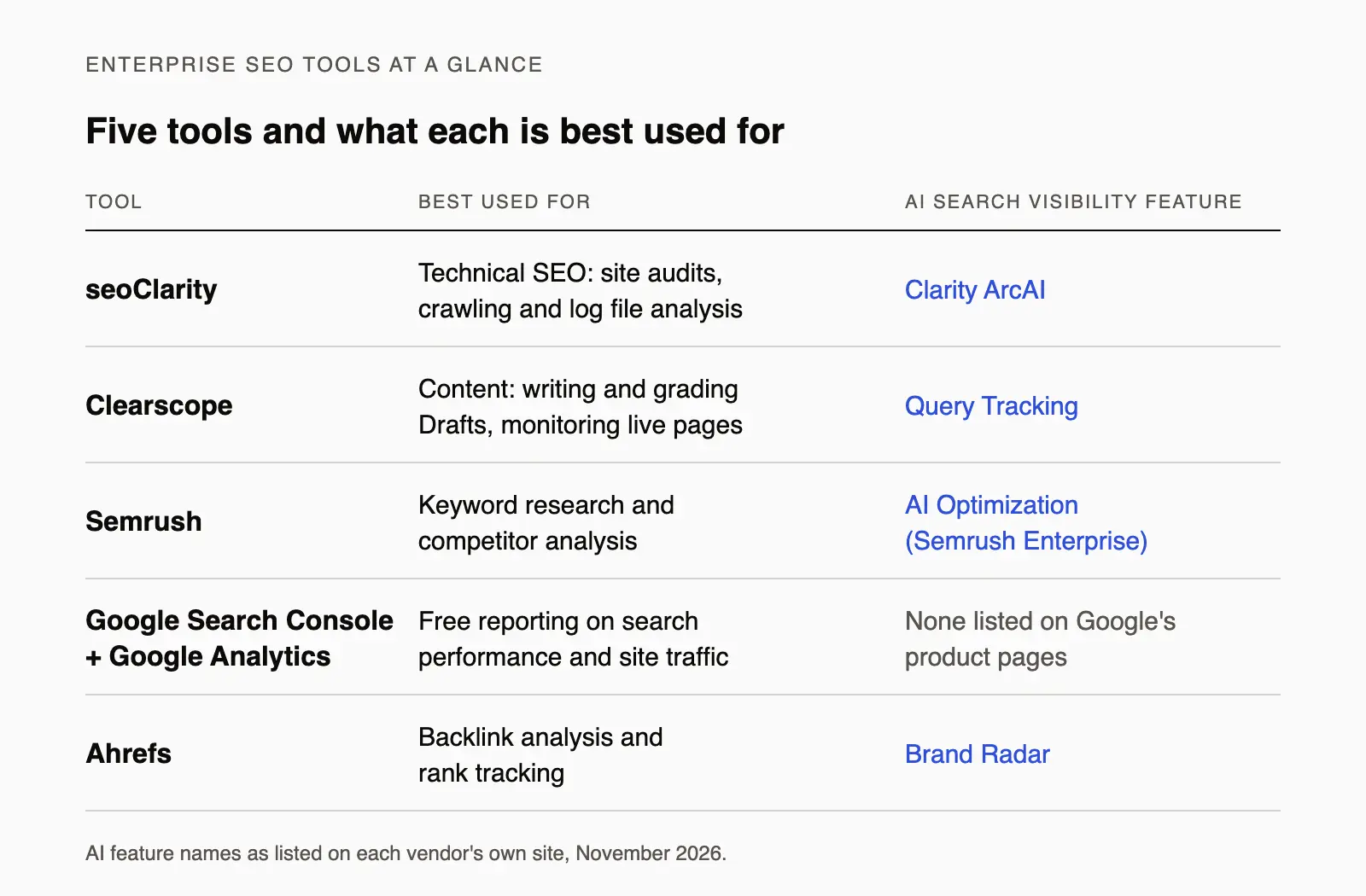
The five enterprise SEO tools in this guide, what each is best used for, and what each vendor calls its AI search visibility feature.
We cover:
A technical SEO solution — seoClarity — that lets you perform site audits and address issues on the back end of your site.
Our content optimization software, Clearscope, with tools to find the questions buyers ask, write and grade content, monitor published pages, track how often AI answers mention your brand, and help you see better ROI from your content marketing.
Semrush, to research new keyword opportunities and keep tabs on competitors’ digital strategies.
Reporting tools — Google Search Console (GSC) & Google Analytics (GA) — to measure overall site performance, track engagement with individual web pages, and dig into website traffic.
Ahrefs, for backlink analysis and rank tracking on your target keywords.
Let’s talk more about these tools and why they work well for enterprise teams.
Note: Clearscope is our product. We’re proud of what we’ve built and believe we have the best content optimization and monitoring platform on the market. Request a personalized demo.
1. seoClarity

seoClarity search engine optimization
seoClarity is an enterprise SEO platform, and the part we focus on here is its technical SEO toolset: site audits, an SEO crawler, page speed checks, internal link analysis, and log file analysis that can determine problem areas and potential opportunities to improve SEO. (seoClarity now describes itself as a unified SEO and AEO platform.)
These technical audits pull the SEO data that enterprise teams need to hone in on key problems, such as slow page speed or poor rankings in search engines.
A site crawl reviews your site architecture and page content to show you what’s hurting performance (like site errors and broken links). seoClarity also lists internal link analysis, link gaps, and link management among its features.
After it crawls your site, the platform surfaces insights to improve performance and support the user experience. ClarityAutomate adds an SEO Split Tester for A/B testing, plus tools such as Page Optimizer, Schema Optimizer, and Link Seeker to automate optimization tasks.
Beyond technical SEO, seoClarity’s modules cover rank tracking (including local SEO), keyword research, content, SEO analytics, and competitive insights.
The platform also connects to your analytics (its pricing page lists Google Analytics and Adobe Analytics integrations, plus Google Search Console data) and offers APIs, so it can work in tandem with your other SEO software.
Some additional things to know about this platform:
seoClarity sells four packages (Rankings, Research & Content, Technical SEO, and Enterprise) and says all packages are priced by the number of domains and keywords you track. You request a custom quote for the package you’re interested in.
The technical features are comprehensive, so plan for a learning curve at the beginning, especially for team members who are new to technical SEO. And that’s why…
seoClarity says each client gets a dedicated Client Success Manager, a week-by-week onboarding plan, and training on the platform.
seoClarity also offers content marketing briefs and AI-powered content creation tools to help you build new website pages and rank for target keywords. However, we recommend our content optimization software, Clearscope, because it has enterprise-level SEO features to drive more efficient content marketing processes and manage outside collaborators.
2. Clearscope

Clearscope content optimization platform
Clearscope is the content piece of the stack. It covers four jobs: finding the questions your buyers ask (Discover), tracking how often AI answers mention your brand (Query Tracking), writing and grading content (Drafts), and monitoring the pages you’ve published (Pages).
Here’s how our platform works:
Monitor Existing Content in Pages
Many enterprise teams start with the content they already have. In Pages, you connect Google Search Console and see each page’s content grade next to its clicks, impressions, position, and SEO value.
Saved views turn that content inventory into a to-do list. There are views for content decay, striking-distance queries, technical issues, and internal linking, and you can save your own views by tag, grade, or URL.
Every chart marks Google updates automatically, and you can add your own notes about what you changed and when. That makes it easier to audit existing website content and to report on content health for the whole site or for one section.
When a page slips, one click sends it to Drafts so you can refresh it.
We also have a guide that outlines the best practices for updating website content.
Write and Refresh Content in Drafts
Drafts give writers a clear target while they write, whether the page is new or due for a refresh.
Each Draft includes:
A content grade from A++ to F, scored against the pages that rank today.
A term map that lines up the terms top-ranking pages use against your draft, so the gaps are obvious.
Icons that show which terms Gemini, ChatGPT, and Claude use in their own answers.
Research on the questions people ask and the sources AI answers lean on.
You can also start with AI. Set a direction and a tone, and Clearscope produces an outline and then a full draft that follows your brand guidelines. Brief templates mean every writer, in-house or freelance, starts from the same plan.
The grade and term guidance update as you type, so you can analyze search intent, cover the topic fully, and handle on-page SEO strategies before the draft goes to an editor. (Our guide to writing SEO content that ranks walks through the process.)
You can easily optimize content for SEO during your natural writing process, so your end product doesn’t sound like “content written for SEO” and you can maintain quality as you write and edit. This streamlines processes because it shows you what to focus on from the start, so content doesn’t require major edits after writing to be optimized for search engines.
Pages and Drafts are two of Clearscope’s four parts. Here is how all four connect:
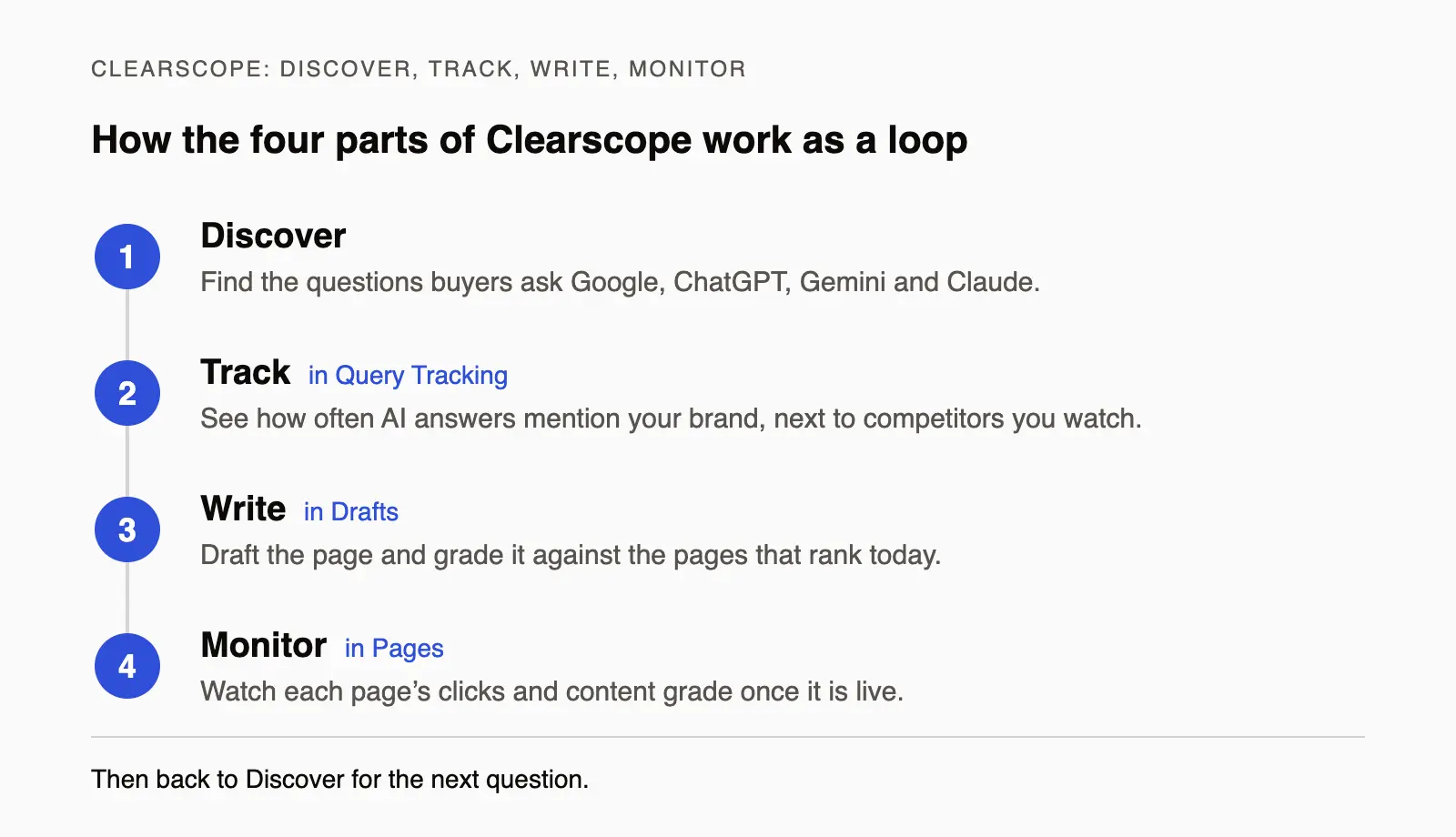
Clearscope’s four parts: Discover, Track (Query Tracking), Write (Drafts), and Monitor (Pages).
Find Questions and Track AI Answers
Discover starts from a topic or a site and returns the questions people ask Google, ChatGPT, Gemini, and Claude. Each one comes with average monthly searches, competition, and CPC, plus the brands each engine already names.
That last part matters because rank tracking only tells you where a page sits in search results. Prompt tracking asks a different question: when someone asks an AI assistant about your category, is your brand in the answer?
Query Tracking is Clearscope’s name for prompt tracking. It runs each query you track every day across Google and three AI engines (ChatGPT, Claude, and Gemini) and shows how often your brand is mentioned next to the competitors you watch.
You can open any response to read the full answer and see exactly where your brand was named. You can also set up a project for each brand you manage and export mention rates and trends for reporting.
Clearscope caters to enterprise teams in a few ways:
Every plan includes unlimited users and unlimited projects, plus unlimited sharing and exporting, so you can send Drafts to freelancers or contractors without buying extra seats.
The content grade and term guidance follow writers into Google Docs, Microsoft Word, and WordPress, so they can optimize content where they already work.
The Enterprise plan adds custom credits, custom agreements, crawler whitelisting, and single sign-on (SSO). Business and Enterprise plans include a dedicated account manager, and every plan comes with live onboarding and training. You can compare plans here.
3. Semrush

Semrush keyword research and competitive analysis tools
Although the SEO solutions above contain keyword research tools, we suggest Semrush to find new keyword opportunities, perform competitor analysis, and plan content creation. That’s because this platform provides a plethora of features to explore topic ideas, research target keywords, and dig into competitors' strategies.
You can use Semrush’s solution to plan organic content strategies or PPC campaigns. The keyword research tools enable you to:
Look up topics and explore keywords around your area of interest.
Uncover long tail keywords you haven’t already targeted.
See which keywords competitors target (in both organic content strategies and PPC campaigns).
Identify gaps between your website content and competitors.
Discover the best keywords for your category and create a master list of opportunities to target.
Then, Semrush's competitive analysis features let you understand how you measure up to competitors and identify opportunities to get ahead. You can:
Analyze competitors’ link building strategies and discover backlink gaps.
Monitor competitor performance and see where they rank in search engines for target keywords.
Measure traffic to competitor sites.
Review competitor strategies (for organic content and paid advertising).
Check your AI visibility: Semrush’s feature list now includes AI visibility and AI brand sentiment.
Identify new competitors as they enter the space.
Like seoClarity above, Semrush lists integrations on its site. It also offers the Semrush API, so you can pull its data into the other SEO tools and reports in your operations.
A note on pricing: Semrush now sells a separate enterprise line called Semrush Enterprise (its site also says Semrush for Enterprise). It includes Enterprise SEO, with market and competitive intelligence and forecasting; AI Optimization, for visibility in AI answers; and Site Intelligence, for crawling very large sites. The enterprise page does not list prices; you book a demo with their team.
4. Google Search Console (GSC) & Google Analytics (GA)
When it comes to reporting tools, we recommend every SEO agency or marketing team use Google Search Console and Google Analytics to closely measure site performance, analyze specific pages, and report on user behaviors.
These tools are available free of charge and can support all business sizes. Large organizations can also talk to Google’s sales team about Analytics 360, which Google describes as tailored to large enterprises, with service level agreements and enterprise-level support.
Here’s how each solution works:
Google Search Console

Google Search Console to measure enterprise website performance
In Google Search Console, the performance reports show:
Top-performing pages — see which pages receive the highest number of clicks and impressions, understand where you appear in search results, and check click-through rates (CTRs).
Keywords you’re already ranking for, and the average rank position — so you know which keywords you have (and haven’t) targeted and which pages are (and aren’t) performing well.
But the focus of this solution is more on the technical side, where they provide tools to show you:
Core Web Vitals reports for mobile and desktop, to stay on top of page experience issues and prevent them from impacting SEO or site performance.
Indexing — so you can review index coverage, submit XML sitemaps and individual URLs for crawling, and use the URL Inspection tool to see crawl, index, and serving information for a page.
Email alerts when Google identifies issues on your site.
Because this data comes from Google itself, Search Console is the first place to check how your site performs in Google Search.
Google Analytics

Google Analytics tools to track detailed traffic and engagement metrics
Google Analytics (the current version is Google Analytics 4, or GA4) has features to gather detailed metrics about website traffic and the user journey.
With Google Analytics, you can:
Learn more about your site traffic — see which audiences you attract, which devices they use to interact with your site, their languages and locations, and how long they visit your site.
Track customer acquisition and see which pages brought in new users (and through which mediums) to measure the effectiveness of organic content, paid marketing strategies, and social media campaigns.
Follow user behavior across a visit — you can see where visitors enter your site, the pages they hit during their journey, and where they convert or leave.
Mark the actions that matter most to your business as key events, then measure which pages drive them and resonate with target audiences. (Google now uses “conversions” for the key events you use to measure ad campaigns.)
These tools expand upon other SEO tools’ reporting capabilities and let you fully gauge your site’s strengths and weaknesses. You have user-friendly technical tools to nip back-end issues in the bud and detailed reporting tools to track what visitors are doing on your site. You have the insights to understand what pages and strategies work well for you, and which ones flop, so you can make data-driven decisions on content and SEO campaigns in the future.
Plus, this also means you can accurately measure how digital strategies contribute to overall business goals; you can report on the pages that drive new organic traffic and support customer acquisition (and see which pages drove actual sales) so you can speak to the value of your projects.
5. Ahrefs

Ahrefs enterprise-level rank tracker and backlink management tools
Last on our list is Ahrefs — a strong choice for backlink analysis and rank tracking.
Its backlink data helps you review the links pointing to your site and guide your strategies; that way, you can ensure your link building efforts have a positive impact on page rankings.
Ahrefs’ Site Explorer lets you:
Review your site’s backlink profile to understand what’s helping rankings (and what’s hurting).
Analyze referring domains to avoid risky links.
Explore competitors’ backlinking strategies.
Find new link opportunities.
Ahrefs’ Rank Tracker has a wide feature set to support rank tracking, including the ability to:
Track keyword rankings — for desktop and mobile, by country, city, or ZIP code — and monitor your ranking progress.
Segment your keyword tracking with tags and presets, and keep tabs on organic search performance for specific keywords.
See which SERP features you appear in, including featured snippets and AI Overviews.
Measure your average search position and share of voice.
Gather data on who you compete with in SERP results (and monitor competitors’ keyword rankings to see how you compare).
Beyond links and rankings, the Ahrefs toolset includes Keywords Explorer for keyword research, Site Audit for technical SEO checks, and Brand Radar for AI search visibility (more on that below).
Ahrefs publishes prices for its self-serve plans, with additional users priced per seat. Its Enterprise plan is sold through the sales team, and the pricing page does not show a price for it.
According to Ahrefs, the Enterprise plan adds:
Uncapped API access and custom API endpoints.
Single sign-on (SSO), access management, and an audit log.
Unlimited historical data, so you can visualize progress as time passes.
A dedicated account manager and tailored onboarding.
Ahrefs also lists monthly webinars and workshops for enterprise customers. (You can also reference Ahrefs Academy, which offers free video courses on digital marketing.)
AI Search Visibility: A Newer Criterion for Enterprise SEO Tools
AI answers are now part of search. Someone researching your category may ask ChatGPT, Gemini, Claude, or Perplexity, or read one of Google’s AI Overviews, and a page that ranks well does not guarantee your brand is mentioned in that answer.
So when you compare enterprise SEO tools, add one more question to your list: does the tool show whether AI answers mention your brand, for which questions, and next to which competitors? Vendors call this prompt tracking, AI visibility, or answer engine optimization (AEO) reporting.
Here’s what each vendor in this guide says on its own site (checked in November 2026):
seoClarity has a product called Clarity ArcAI, which lists AI search visibility tracking and AI Overviews tracking among its features.
Clearscope has Query Tracking, which shows your mention rate in ChatGPT, Claude, Gemini, and Google next to the competitors you watch.
Semrush sells AI Optimization as part of Semrush Enterprise. Semrush says it tracks brand visibility across AI models, including brand mentions, sources, and competitors.
Ahrefs has Brand Radar, which tracks your brand’s mentions and citations across AI Overviews, AI Mode, ChatGPT, Perplexity, Gemini, and Copilot and reports an AI share of voice.
Google Search Console and Google Analytics report on your own site’s search performance and traffic. The Google product pages we checked for this guide don’t list a report on brand mentions in AI answers, so plan to pair them with one of the tools above.
Feature names and coverage change quickly in this area. Before you buy, check which AI engines a tool covers, how often it runs each prompt, and whether you can read the full answers. For a wider look at this category, see our list of AI search visibility tools.
Getting Started
This guide covers five tools to consider getting started with, not the whole market. BrightEdge, Conductor, and Siteimprove, for example, also sell enterprise SEO platforms, and roundups of this market often list Botify and Moz Pro, too. Whichever tools you shortlist, compare them on the same criteria: technical audits, content, keyword tracking, reporting, integrations and API access, collaboration, pricing, and AI search visibility.
Our team is available to answer any questions you may have about enterprise SEO software and Clearscope’s solution, so you can understand which tools and packages will best support your teams and workflows.

12 Content Promotion Strategies To Strengthen Your Content Marketing
Content promotion is crucial for your content to reach a wide audience. Let’s explore content promotion strategies to boost B2C and B2B content marketing.
Why Search Intent Optimization Beats Keyword Optimization
Optimizing for search intent vs. SEO keywords: Which is better? Explore the difference between keyword and intent-based SEO strategies.
Information Gain in SEO: The Guide to Convincing Yourself, Team, and Clients to Rethink Current Strategies
What is information gain? Why is everyone talking about it? This is the guide you need to persuade yourself, your team, and your clients to reassess your current strategy to include info gain in your content.