Stop Tracking AI Prompts Every Day (and What To Do Instead)
Topic: Reporting
Published:
Written by: Clearscope
AI answers change over time. Ask the same prompt twice and you’ll often get slightly different responses. Run it again a minute later and something else might shift.
Because of that volatility, many teams assume the only way to measure AI visibility is to track prompts continuously by running the same searches day after day to see what changes.
But that assumption misses something important. When you look underneath the responses at how models retrieve information before generating answers, a different picture emerges. While the outputs may fluctuate, the search behavior behind them is far more structured than it appears.
And once you understand that structure, the logic of tracking prompts every day starts to fall apart.
Behavior Over Time
To test how much time actually affects prompt responses, we ran a prompt 100 times within a two-minute window, then repeated the same prompt 100 more times across the following seven days.
Across that week-long period, Gemini introduced 23 new queries, representing about 29% growth in the query set. In other words, most of the query variation appeared immediately. The additional variability introduced over time was relatively small. This suggests that time accounts for only part of the variability we see in AI responses.
GPT showed even less expansion across the same period. When it searched, it relied on an even smaller cluster of query structures. At the same time, the overall search space remained surprisingly bounded. A single 100-response control sample captured between 74% and 100% of the queries that appeared in later runs, along with 86% to 100% of the brands that surfaced in responses. That means most of the retrieval patterns show up quickly once you sample enough responses. That raises an important question: if time isn’t the primary driver of response variability, what is?
Our data suggests the answer lies in the models themselves. Specifically, in how they construct answers through retrieval.
The Law of Diminishing Returns
This has an important implication for how AI visibility should be measured.
If most retrieval patterns appear in the first large sample, running the same prompts over and over again day after day may not actually reveal much new.
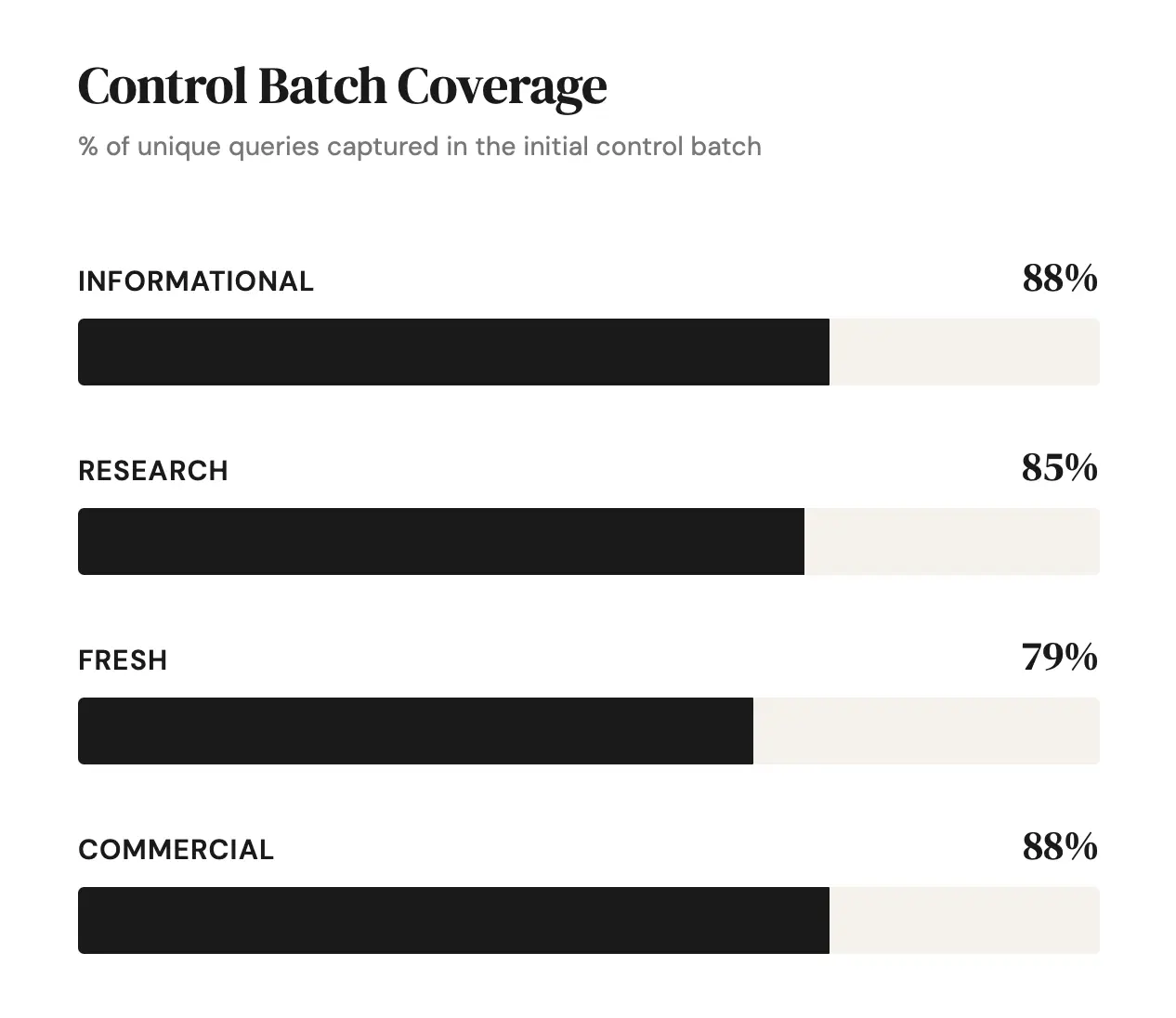
In our analysis, the first batch captured most of the retrieval universe. After that, additional runs mostly surfaced the same query structures, with only occasional small variations. In practice, that means a large one-time sample can show you much of the retrieval behavior you’d otherwise see by tracking prompts over time.
Across a full week of testing, new queries were limited and predictable — not constantly expanding.
Daily monitoring mostly surfaced small differences in how answers were written rather than new strategic insight.
In other words, there’s a clear point where the returns start to drop off.
Running the same prompts repeatedly tends to produce more variation in phrasing than in the underlying search patterns that determine which sources and brands appear.
So… What Should You Do Instead?
If most retrieval patterns appear in the first large sample, repeating the same prompts every day usually doesn’t reveal much new information.
As we saw earlier, a large sample captured most of the queries and brands that appeared later.After that, additional runs mostly returned the same query patterns with only small variations. In other words, there’s a point where more tracking stops adding much insight. AI answers might look volatile on the surface, but the retrieval behavior behind them is far more stable than it seems.
Which leads to a simple takeaway: smarter sampling beats constant tracking.
Instead of running the same prompts every day, focus on sampling responses at scale. Larger batches give you a much clearer picture of the queries, sources, and brands that appear again and again.
For example, running a batch of 20, 50, or 100 responses for an important prompt can quickly reveal the patterns that matter. In many cases, those larger samples capture most of the queries and sources the model is likely to use.
[[Add visual for 20, 50, 100 similarities]]
Once you see those patterns, you start to understand the space the model is actually pulling from: the queries it tends to generate, the domains it repeatedly cites, and the brands that appear across responses.
Those are the competitors you’re actually up against inside AI answers. So from there, the goal is simple: compete in that space. Create content that addresses the queries models generate and build authority alongside the sources that already appear.
In other words, sampling helps you see where the real competition is. And once you understand that landscape, you don’t need to watch the same prompt every day to know what’s happening.
The Bigger Shift
AI answers can look unpredictable when you watch them day by day. But underneath that surface volatility, the systems producing those answers are far more structured than they appear. The queries models generate, the sources they retrieve, and the brands that surface in responses tend to follow recognizable patterns.
That’s why tracking prompts endlessly often creates the illusion of change without revealing much new insight. The real opportunity isn’t watching answers fluctuate. It’s understanding the retrieval universe behind them and learning how to compete inside it.
Why Some AI Models Are Harder to Influence Than Others
Why influencing AI answers isn’t random. Learn how GPT and Gemini retrieve information differently and why search behavior determines AI visibility.
How to Reverse-Engineer the Prompts Your Customers Actually Use
Most teams track the wrong prompts when measuring AI visibility. Learn how real user questions shape AI recommendations and how to uncover them.
11 takeaways From Clearscope’s Roundtable on the Future of Search in 2026
Key takeaways from Clearscope’s AI search roundtable with Lily Ray, Kevin Indig, Ross Hudgens, and Steve Toth on SEO, AEO, and what matters in 2026.