Bad News: It's Not Just Listicles
Topic: Clearscope
Published:
Written by: Bernard Huang
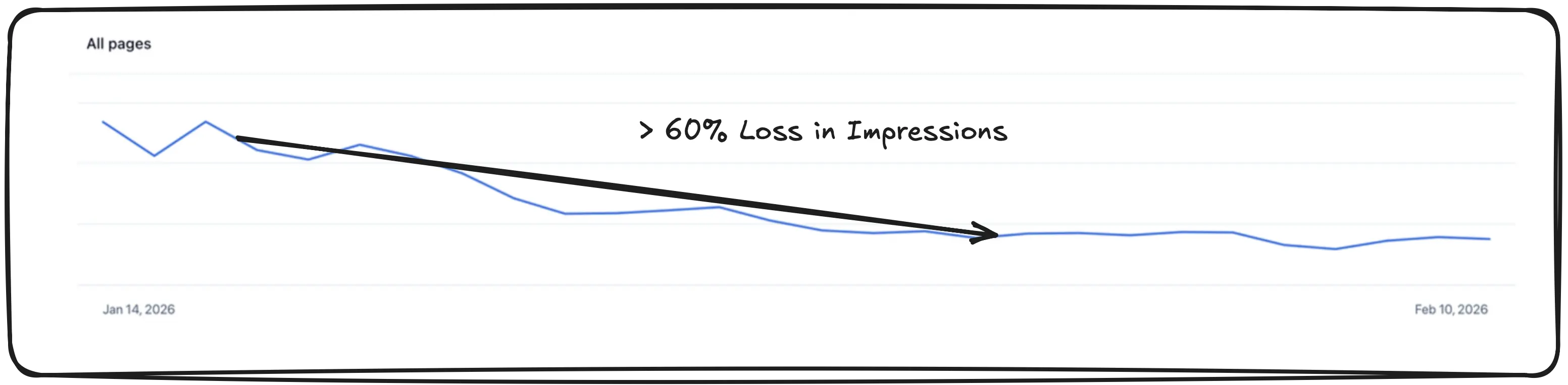
In January, we saw a decline in organic traffic. A quick search on Linkedin told us we weren't alone. Across industries, teams shared similar patterns: impressions and clicks trending down after a stable December.
The immediate question was whether this was tied to Google’s December core update that completed on December 29. The theory was simple: Google had started deprioritizing listicles that included self-promotion — specifically, pages ranking for “best” or comparison-style queries where the publisher’s own product was featured prominently and favorably.
Given Google’s repeated emphasis on helpful content and transparent evaluation, that explanation felt plausible. If Google had tightened how it evaluates self-promotional content, listicles would be the most obvious place to look. So we went digging…
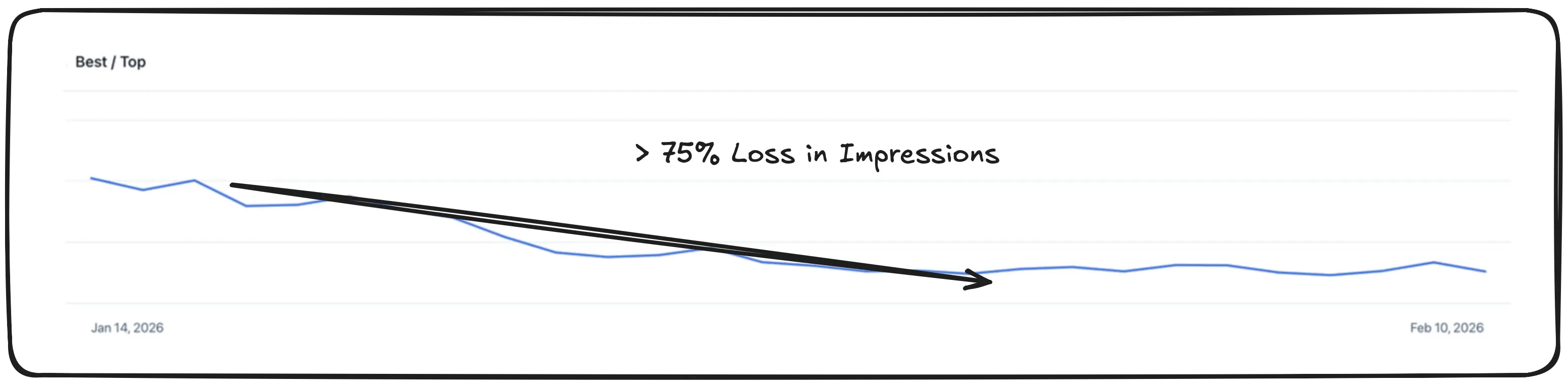
But something wasn't adding up. The loss in traffic for promotional content only accounted for ~55% of our overall decline.
So we went back to testing that assumption by comparing performance across all content type categories. If a content type were the issue, the data should show divergence.
Instead, what we found was broad-based decline across a few key content types.
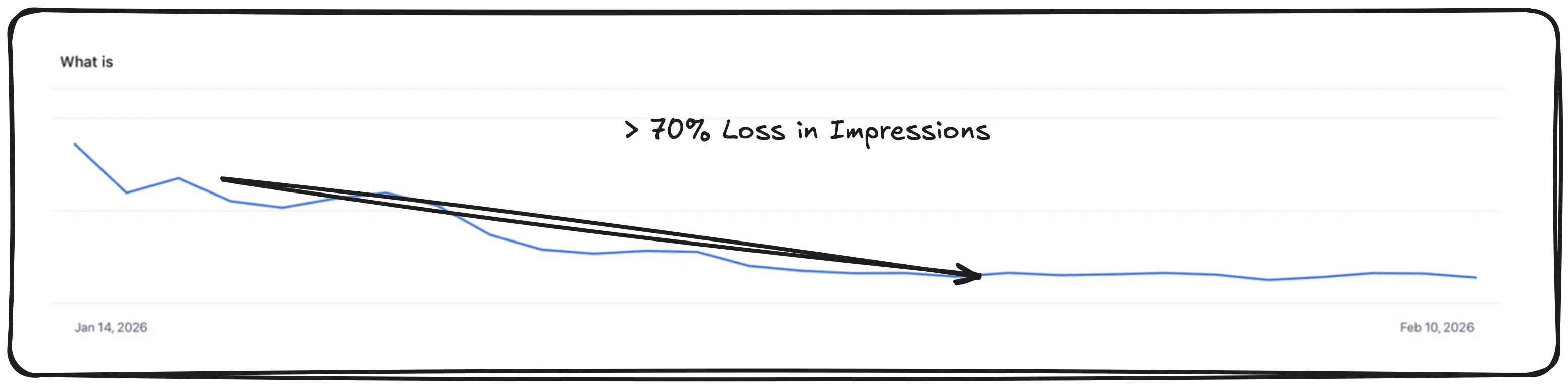
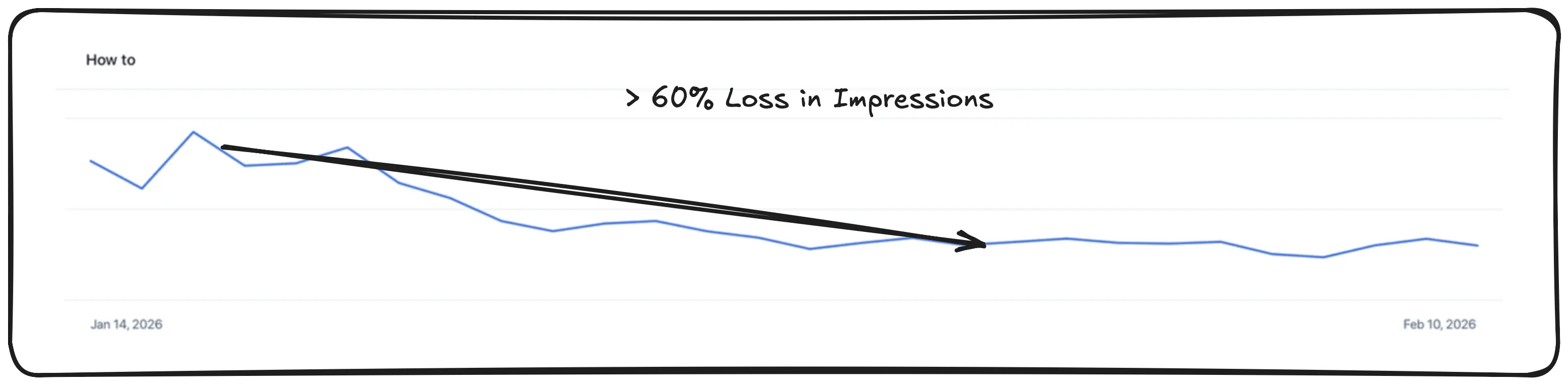
After seeing this, it became difficult to argue that this was a format-level adjustment. That changed the entire theory. Something broader was happening.
If It’s Not Format, What Changed?
Once we ruled out a format-specific impact, the next question became structural: what changed in the search surface itself?
The December core update may explain some volatility. But the more significant shift appears to have happened later in mid January. We then found that in January, while Google didn't publish a core update it did complete a rollout making Gemini 3 the model that powers AI Overviews.
"First, we’re making Gemini 3 the new default model for AI Overviews globally, so you get a best-in-class AI response right on the search results page, for questions where it’s helpful."
Reference: https://blog.google/products-and-platforms/products/search/ai-mode-ai-overviews-updates/
We began seeing:
Fresher information reflected in answers. The newer Gemini model appears to incorporate more recent context than earlier iterations, expanding the range of queries that can be fully resolved without requiring additional searches.
Longer, multi-step reasoning chains. Instead of short summaries, Overviews increasingly synthesize across multiple subtopics, creating broader “fan-out” responses within a single answer.
More complete intent resolution directly in the AI overview. Complex comparison and evaluation tasks are handled in a single response rather than requiring multiple follow-up queries.
Changes to the follow-up experience. Google introduced a more seamless conversational flow, allowing users to ask follow-up questions directly from the AI Overview and move into an AI-driven back-and-forth without returning to the traditional SERP.
These are not cosmetic interface changes. They meaningfully reduce the friction required to complete a task inside the search results.
When AI Overviews become more capable at resolving intent, fewer users need to scroll down, to click through to individual pages. In some cases, fewer follow-up queries are even necessary.
This produces two measurable effects:
Impression volume declining. Especially across queries with high consensus (what is, how-to, listicles)
Click-through rates decline
That pattern aligns with what we observed.
It's Not a "Crackdown" Situation
This was the aha moment for us the decline was not isolated to self promoting content. It extended across multiple content categories.
If this were a targeted adjustment aimed at self-promotional listicles, we would expect to see concentrated impact in a narrow set of page types. Instead, performance trends moved in parallel across categories. That pattern is difficult to reconcile with a penalty-based explanation.
A structural explanation fits the data more cleanly.
Over the past year, Google has continued expanding AI Overviews and improving the underlying models that power them. As those models become more capable, they are able to:
Synthesize structured comparisons across multiple sources
Summarize long-form guides into concise, task-oriented answers
Resolve multi-step questions within a single response
When more of the original intent is fulfilled directly in the search results, fewer individual pages are required to complete the task. Rankings may still exist, but the functional value of a ranking shifts.
Search is increasingly satisfying intent before a click ever occurs. That changes the dynamics of visibility in ways that look systemic, not punitive.
What This Means for SEO
If this were a format-specific issue, the response would be tactical. You would adjust the page type, revise comparison frameworks, reduce self-preference, or rethink how certain queries are targeted.
But if the shift is systemic, the response must be strategic.
The underlying change is not about how one type of page is evaluated. It is about where visibility now occurs. Increasingly, answers are being constructed directly in the search interface. That moves part of the competitive surface away from blue-link rankings and into AI-generated summaries.
In that environment, performance is no longer defined solely by rank position or page-level traffic. It also depends on whether your content is represented inside the answer layer.
That changes how success should be measured. It increasingly includes:
Being a part of the conversations searchers are having in AI
Influencing how AI systems synthesize comparisons and reasoning
Structuring content so it can be extracted, interpreted, and cited
This is not a short-term fluctuation tied to a single update cycle. It reflects a continued transition: AI systems are capturing more of the intent resolution process. Each model upgrade increases answer completeness. Each interface improvement reduces the need for navigation. Over time, that compresses the traditional organic traffic model.
The implication is uncomfortable but important: For many sites, organic traffic is unlikely to return to prior baselines. The surface area of search is changing.
That doesn’t mean SEO is over. It means the objective is evolving.
This is not a short-term fluctuation tied to a single update cycle. It reflects a broader evolution in how search systems fulfill intent. As models become more capable, the percentage of queries resolved before a click increases. Optimization strategies have to account for that reality.
The Future of SEO Is Conversational
Search is now a conversation. Learn how to get cited by ChatGPT, Gemini & Perplexity—and why AEO is the new SEO.
Your Organic Traffic Is Not Coming Back (The Sky Is Falling—and That’s Okay)
The search era has shifted from retrieval to generation. Organic traffic won’t return, but brand visibility is expanding across AI systems. Here’s how to adapt.
The 2026 SEO Playbook: How AI Is Reshaping Search
Learn how generative engines, AI answers, and conversational interfaces are reshaping SEO in 2026, and what brands must do to stay visible across both retrieval and reasoning systems.