Your Organic Traffic Is Not Coming Back (The Sky Is Falling—and That’s Okay)
Topic: Strategy
Published:
Written by: Bernard Huang
For more than two decades, organic search traffic has been one of the most dependable acquisition channels for businesses. Entire content programs, SEO teams, and growth models were built around a stable exchange: create relevant content, earn visibility on results pages, capture clicks, and convert a predictable portion of that traffic. Even when Google updated its algorithms or changed its ranking factors, the underlying promise of SEO remained constant. If you invested in the work, organic traffic followed.
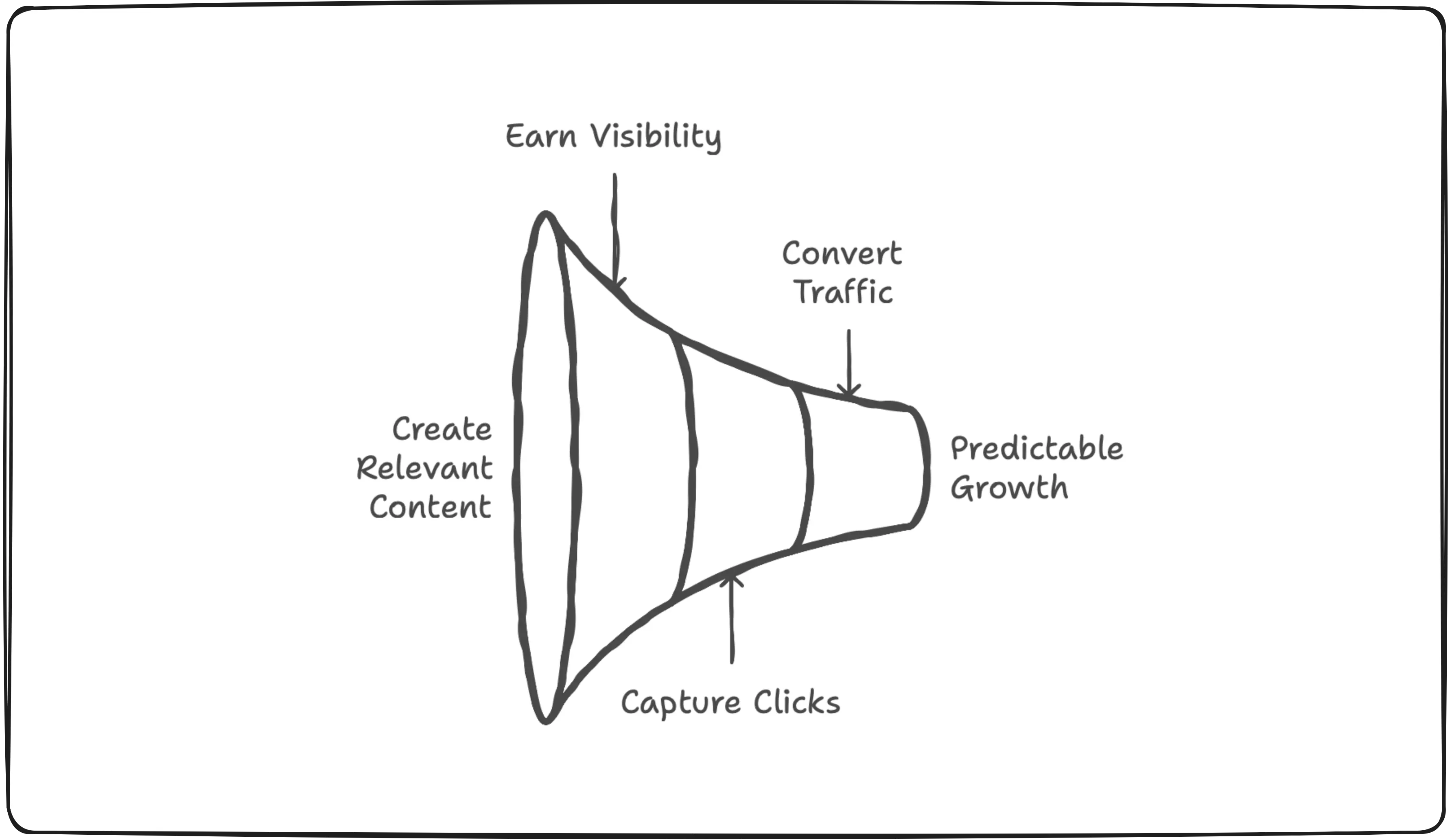
Over the last eighteen months, that promise has unraveled. This isn't because of a single update or a temporary shift in search behavior, but because the underlying mechanics of discovery have changed. The decline many teams are now seeing is not cyclical. It is structural. It reflects a transition from a retrieval-based search ecosystem to a generative one, and that transition has permanently altered where and how visibility happens online.
Organic traffic, as we knew it, will not return to its previous baseline. But the opportunity for brand visibility is not disappearing. It’s moving. And the companies that recognize this early will be the ones who define the next decade of search.
The Retrieval Era Has Ended
Traditional search operated through retrieval: users typed a query, search engines matched that query to documents, and the user selected from a ranked list of links. Keyword research, technical optimization, backlink acquisition: nearly every part of the SEO playbook existed to help a specific page become the most relevant retrieval target.
That no longer defines how answers are delivered, because AI systems generate answers, not lists.
Models like ChatGPT, Gemini, and Google’s AI Overviews:
Synthesize information from multiple sources
Collapse decision-making into a single response
Resolve intent before the user ever clicks
Surface brands at the entity level, not the URL level
In this generative environment, visibility is determined not by ranking position but by whether the model understands a brand well enough to incorporate it into the synthesized output.
This is why organic traffic declines aren’t “recovering”: the click is no longer the primary endpoint of the search journey.
User Behavior Has Shifted Faster Than Search Systems Have
It’s easy to think declining traffic as something Google “took away.” But users changed long before Google formalized those behaviors inside AI Overviews.
The reality is that people want fewer steps and faster decisions. Today’s user expects a single, synthesized answer delivered with minimal effort. They want less cognitive load, fewer open tabs, and guidance that feels immediate and confident. Increasingly, people prefer recommendations over exploration—they don’t want to compare ten sources when one well-reasoned response will do.
As a result, even when a brand’s content provides the underlying information that powers an AI-generated answer, users often don't feel the need to click through. The content already fulfilled its purpose without requiring a site visit.
Organic traffic is dropping not because the information is less valuable, but because the click itself has become optional.
The Long Long Tail Has Outgrown Page-Level SEO
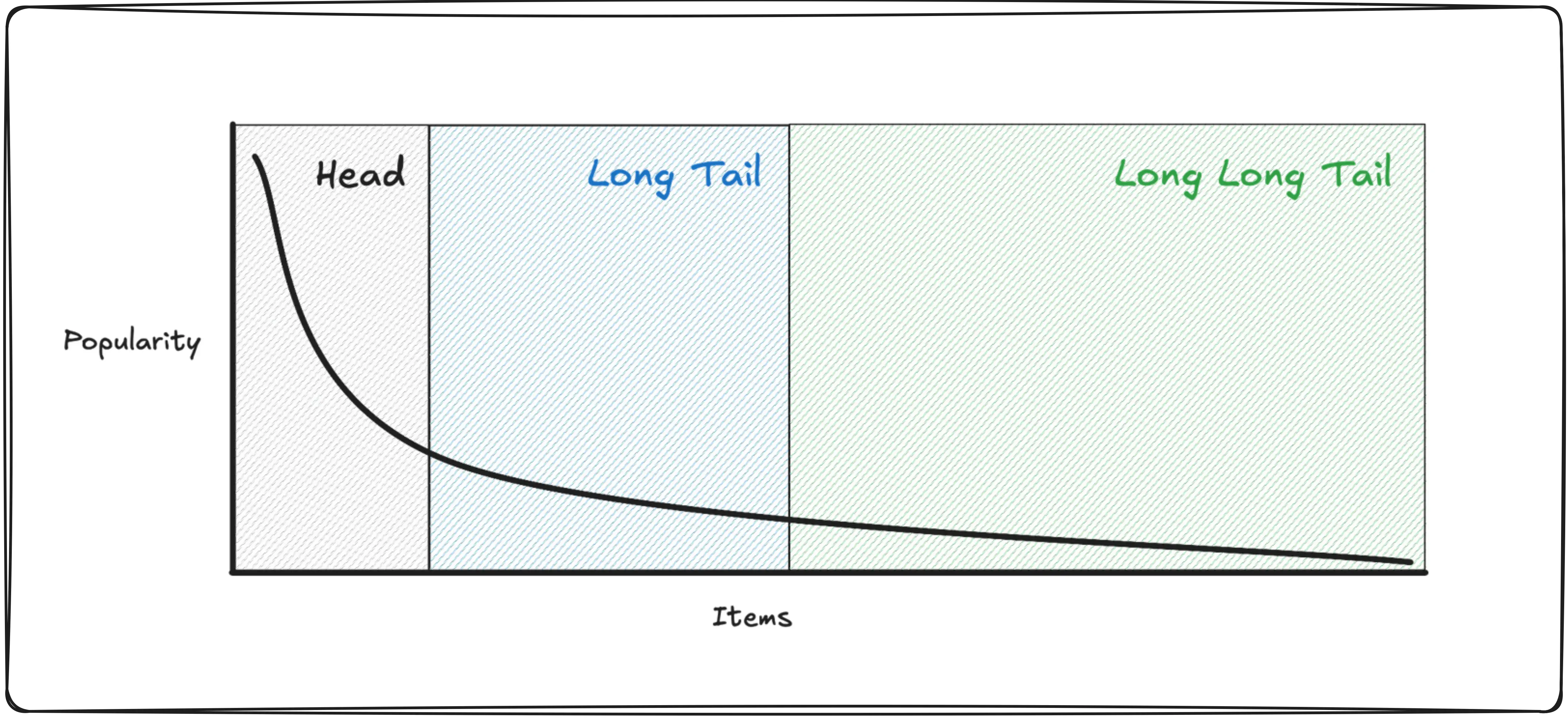
One of the clearest shifts we’re seeing across AI search is the expansion of what we call the Long Long Tail—a dramatic increase in query complexity, length, and context.
AI prompts are longer than traditional queries, more conversational, and multi-intent. Because of these, searches are often not represented in keyword tools at all. But even if they were, no team can publish fast enough to match this surface area.
The expansion of conversational, multi-intent search has grown far beyond what human publishing can realistically cover. As a result, AI systems increasingly draw from a brand’s latent knowledge rather than individual pages, which means page-level optimization matters less than it once did.
What becomes more important is the consistency of the brand’s expertise across its entire body of work. In this environment, semantic breadth, not volume for its own sake, emerges as a true competitive advantage.
Search Has Moved From Mechanical Signals to Cognitive Signals
The SEO era rewarded mechanical signals: keyword usage, internal linking, backlinks, schema, and URL-level E-E-A-T. These still matter, but they no longer dictate visibility in a deterministic way.
AI systems now prioritize brand understanding over page-level optimization. Instead of evaluating isolated documents, models look for whether a brand’s expertise is clearly defined, whether its contributions remain consistent across different contexts, and whether it fits meaningfully into the knowledge graph surrounding a topic.
They also assess whether the brand’s information helps the model construct a confident, coherent answer. In place of the old question, “Which page follows best practices?," AI systems now ask, “Which entities help me build the best answer?”
It’s a very different system of ranking, and one that increasingly decouples visibility from traditional traffic.
Organic Traffic Won’t Recover, but Discoverability Is Expanding
The idea that organic traffic will “come back” assumes that the search interface remains the primary place where discovery occurs. That’s no longer the case, because visibility is now distributed across AI agents
Brands can now appear in ChatGPT answers, Gemini responses, Perplexity citations, AI Overviews, Amazon Rufus recommendations, and more.
These surfaces represent a major expansion of discovery. But the mechanism of visibility has changed.
Instead of clicks, we now measure:
Citations
Mentions
Model recall
Term presence
Brand inclusion in reasoning
Traffic is no longer the leading indicator.
What Brands Should Do Next
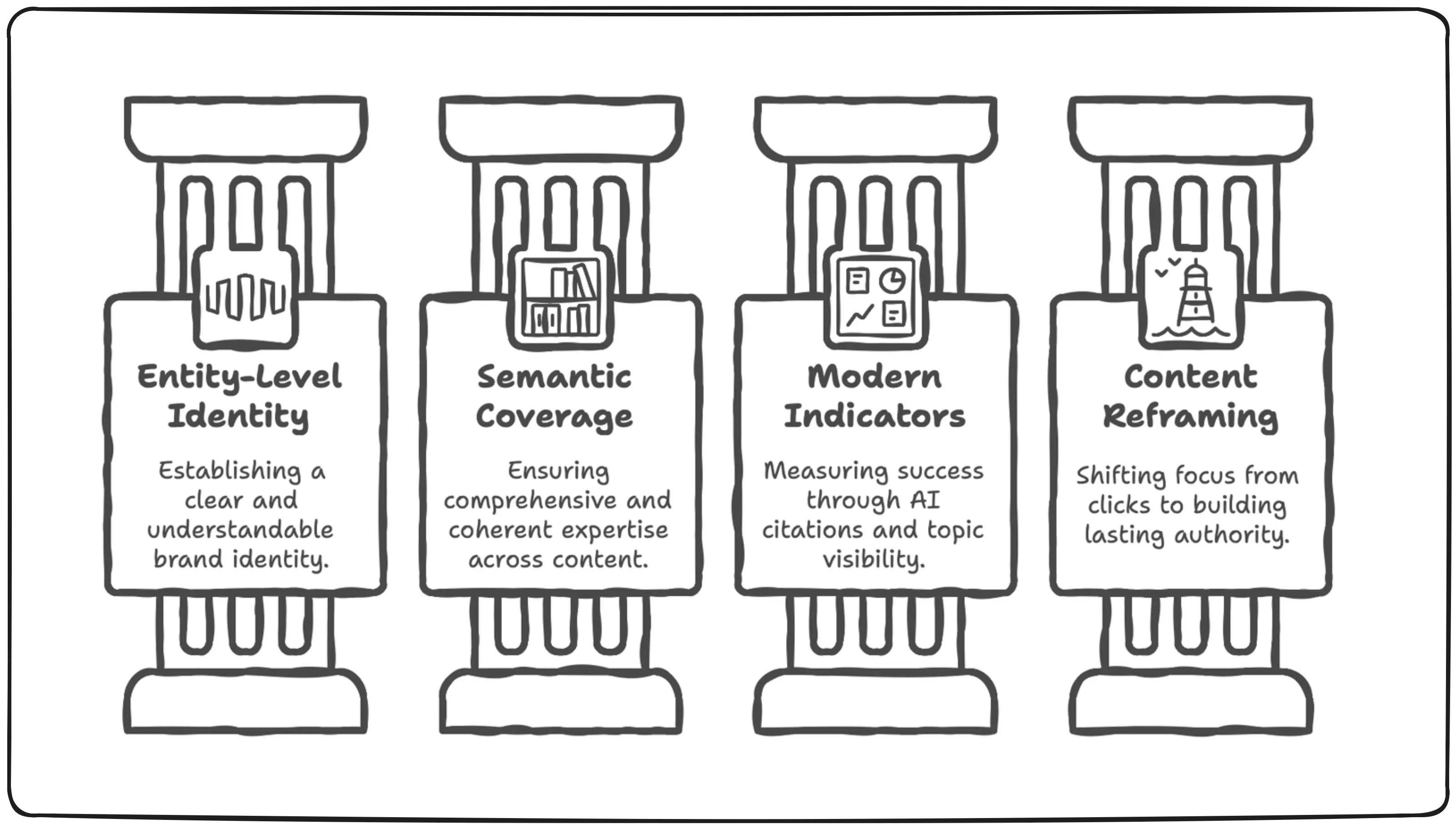
Recovering organic traffic is not the goal, because the mechanics that once delivered that traffic no longer define how users discover information. The new objective is building model-level visibility: ensuring that AI systems understand, trust, and surface your brand across the many generative interfaces where decisions now begin.
To make that shift effectively, teams should focus on the following areas:
1. Strengthen your entity-level identity.
Make it easy for AI systems to understand:
Who you are
What you do
What you’re authoritative about
Where you fit within adjacent concepts
2. Expand semantic coverage.
Not by publishing bulk content, but by ensuring your body of work reinforces a clear, coherent domain of expertise.
3. Measure the right signals.
Modern leading indicators include:
AI citations
Term presence inside generated answers
Topic-level visibility
Breadth of conceptual coverage
Consistency across all content
4. Reframe the purpose of content.
The goal is no longer simply to earn clicks.
It is to:
Become the brand the model reaches for
Shape how AI systems reason
Build authority that persists across interfaces
Create content that reinforces your place in the knowledge graph
This is a shift from optimizing pages to optimizing understanding.
The Sky Isn’t Falling—The Industry Is Evolving
Organic traffic will not return to the patterns that defined SEO from 2010 to 2020. But visibility is not disappearing. It’s migrating to a higher, more contextual layer of search.
We’re entering an era where:
The best answer matters more than the best ranking
Brands are surfaced based on conceptual relevance, not optimization tricks
Discovery flows through intelligent systems, not solely through SERPs
Content is evaluated holistically, not page by page
The companies that adapt to this reality will see their influence grow, even if their traffic charts never look the same.
Organic traffic isn’t coming back.
But the opportunity to shape how AI systems understand, trust, and surface your brand has never been greater.
The Long Long Tail Is Here — and It’s Changing Everything
Discover why AI search rewards depth, connections, and semantic authority — and how the “long long tail” reshapes modern SEO and brand visibility.
The 2026 SEO Playbook: How AI Is Reshaping Search
Learn how generative engines, AI answers, and conversational interfaces are reshaping SEO in 2026, and what brands must do to stay visible across both retrieval and reasoning systems.
The Future of SEO Is Conversational
Search is now a conversation. Learn how to get cited by ChatGPT, Gemini & Perplexity—and why AEO is the new SEO.