Why Model Knowledge Cutoffs Will Matter Less and Less Over Time
Topic: Reporting
Published:
Written by: Bernard Huang
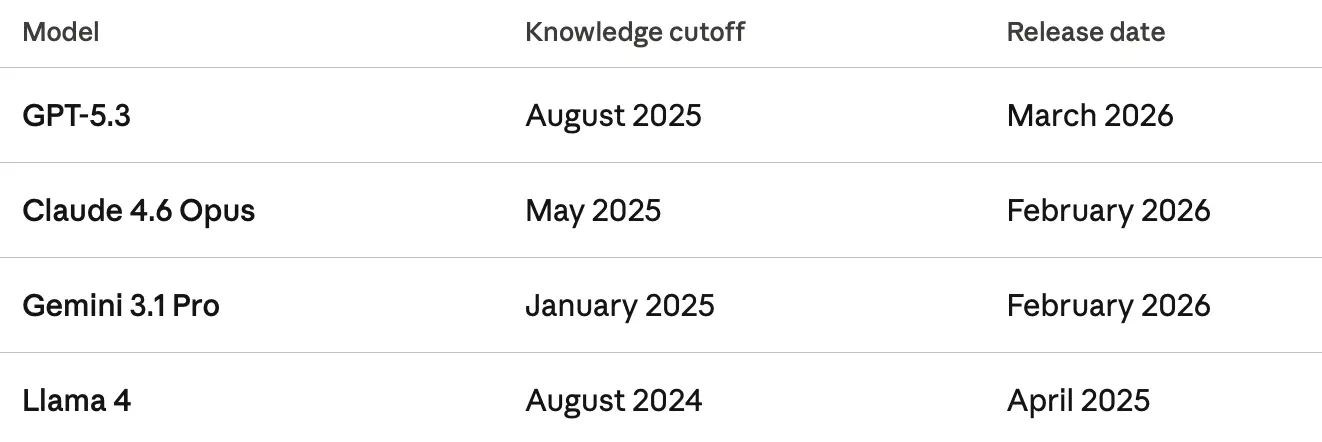
For years, one of the first questions people asked about any AI model was its knowledge cutoff. When was it trained? Does it know about things from last quarter? Will the next model version finally include the information we need?
These were reasonable questions. They made sense when AI systems worked primarily from internal memory. Everything the model knew was locked in at training time, and nothing new could enter until someone retrained the whole system from scratch.
But that assumption is starting to break down. As AI systems increasingly retrieve information before answering, the knowledge cutoff is becoming a less meaningful constraint. Understanding why requires looking at two things at once: what's changing in how AI systems are built, and what that means for how content becomes visible inside AI-generated responses.
The Problem With "Retraining"
Retraining a large model is expensive. It requires significant compute, coordination, and time. But cost isn't the only reason retraining is becoming less appealing. The internet itself is changing.
A growing share of online content is now generated by AI. If models continue retraining on the full web, they risk learning from their own prior outputs: a feedback loop that gradually degrades the reliability of information over time. The more the web fills with AI-generated text, the more retraining on it risks compounding errors rather than correcting them.
Even setting that aside, retraining still wouldn't solve the core problem: the world doesn't hold still.
Training a model creates a snapshot of the internet at a specific moment. But research gets published. Companies release products. Events happen. Information gets corrected and updated every day. No matter how good a training run is, the resulting model will always be chasing a reality that has already moved on.
The Shift Toward Retrieval
Because of these constraints, many AI systems are now designed differently.
Rather than relying exclusively on what was memorized during training, they retrieve information before generating a response. They search the web, identify relevant sources, and use what they find to construct an answer.
This approach — often called retrieval-augmented generation, or RAG — changes the fundamental relationship between a model and its knowledge. The model's training data becomes a baseline rather than a ceiling. What the model can access is no longer fixed at the moment the training run ended.
This matters practically. Instead of waiting for a full retraining cycle to incorporate new information, developers can make smaller, targeted updates: adding recent developments, correcting outdated information, including recent highlights. Think of it less like rebuilding a system and more like pushing a software update.
The result is that new information can influence AI answers much faster than the old model would allow.
What This Means for Content Visibilty
Under the old model — where answers came from training data — visibility in AI systems depended on what the model had absorbed months or years earlier during training. That was largely outside the control of individual publishers or companies. You couldn't do much to influence what a model had already memorized.
But retrieval changes the question entirely. When AI systems retrieve information before answering, the relevant question becomes: what sources does the AI choose to read? That is a competitive question. It operates in real time. And unlike training data, it responds to the same signals that traditional search has always rewarded: relevance, structure, authority, topical coverage, and indexability.
As we know, influence doesn't happen inside the model's training data. It happens at the moment of retrieval. The candidate set — the pool of documents an AI considers before generating a response — is where visibility is actually won or lost.
Waiting for the Next Model Update Is Not a Strategy
If AI answers depended primarily on training data, a passive approach might make sense: publish content, wait for the next model update, hope for inclusion. The timeline was slow, but the logic held.
Retrieval-driven systems don't work that way.
AI models decide what to read every time they answer a question. If your content isn't part of the set they retrieve today, no amount of patience will change that. There is no next training cycle to wait for. The decision happens at the moment of the query, based on what's available and retrievable right now.
The buying journey has shifted. Discovery now happens inside AI answers before users ever reach a website. If a brand isn't present in those answers, it's not present in that stage of the decision, regardless of how strong its traditional search rankings might be.
Gartner predicts that by 2026, traditional search engine volume will decline 25% as users migrate to AI chatbots. That traffic isn't disappearing. It's moving into AI-generated responses. And those responses are assembled from retrieved documents, not from stored memory.
The Shift In Optimization
This is where the SEO-to-AEO transition becomes concrete.
Search engine optimization was built around ranking: get the right page to appear in the right position on a results page. Answer engine optimization is built around retrieval: get the right content into the candidate set an AI consults before generating a response.
The goal isn't to show up in search results. It's to be cited as a source in AI-generated answers. Those are different targets, and they respond to somewhat different inputs.
The signals that matter for retrieval overlap significantly with traditional SEO fundamentals: crawlability, topical authority, clear structure, strong E-E-A-T. But the framing shifts. The question isn't "how do I rank for this keyword?" It's "when an AI searches for information on this topic, will my content be in the set it considers?"
That shift in framing has practical consequences:
Comprehensiveness matters more than ever. A document that covers a topic thoroughly is more likely to surface across multiple retrieval queries than one optimized for a single narrow phrase.
Structure aids extraction. AI systems synthesize from what they retrieve. Content that is clearly organized and directly answers questions is easier to incorporate into generated responses.
Freshness is a real factor. Brands leading in AEO update their content regularly, quarterly at minimum. Stale content doesn't just rank poorly; it may not be retrieved at all for queries where recency signals matter.
Authority still compounds. Domains that surface frequently across diverse retrieval events carry more structural weight than those that appear sporadically.
The Boundary Is Desolving
Knowledge cutoffs used to define what an AI system could know. The date of the last training run was a hard limit. It was like a a wall between what the model understood and what had happened since. Thankfully, that wall is coming down.
As a model ages further past its knowledge cutoff, it loses relevance over time. RAG systems connect models with supplemental external data in real time and incorporate up-to-date information into generated responses. The cutoff is no longer the binding constraint it once was.
The real question was never "what did the model memorize?" The real question, the one that determines whether your content appears in an AI-generated answer, is what the model chooses to read before it responds.
That question has an answer. And it's one content teams can actually work with.
Ready to Close the Gap Between Ranking and Retrieval?
The knowledge cutoff was never the right thing to optimize around. It was a constraint—a technical artifact of how models were built— and it's gradually becoming a less meaningful one.
What's replacing it is a live, competitive environment. AI systems retrieve before they respond. That retrieval layer interacts with the real web, in real time, and it selects from a finite pool of content. Either your brand is in that pool or it isn't.
Clearscope is built for exactly this environment. It helps content teams identify the topics AI systems consistently retrieve from, understand what topical coverage looks like at the depth that earns inclusion, and build the structural authority that makes content competitive, whether the reader is a human on a search results page or an AI assembling a response.
If your content strategy is still built around ranking rather than retrieval, now is the right time to close that gap.
The Search Engine Wars Are Back. This Time It’s AI
The search wars are back—now inside AI answers. Learn why SEO is shifting to retrieval and how to stay visible in tools like GPT and Gemini.
How to Actually Influence AI Answers
You can’t change a model’s memory, but you can influence what it retrieves. Learn how AI answers are shaped by web searches and the recurring retrieval set.
Why Some AI Models Are Harder to Influence Than Others
Why influencing AI answers isn’t random. Learn how GPT and Gemini retrieve information differently and why search behavior determines AI visibility.